Long-Term Sea Level Rise Scenarios

A recent study in the journal Nature Climate Change could be an excellent reading for a climate change course’s science modules, as well as discussion of the development of adaptation scenarios and responses. The study, which focuses on long-term (2300) projections of sea level rise under 1.5C and 2.0C temperate rise scenarios employed a semi-empirical model calibrated with sea-level data from the past millennium to make these projections. The study also has implications for the timing of emissions reductions over the course of this century.

Among the take-aways of the study:

  1. Reducing temperature increases to 1.5-2C from the reference case halves projected sea level rise rates by 2100, but the rise is still three times the present rate at that point
    1. Even under the impossible scenario of zero greenhouse gas emissions by 2016, sea level rise rates are still double present day values by the 2050s, thought the rate slowly declines thereafter
  2. While the reference scenario leads to sea level rise of 102 (72-139) centimeters over the course of the 21st Century, the 1.5 and 2C scenarios limits sea level rise to about 7 centimeters by 2100. However, this would require negative emissions mechanisms, e.g. biomass or carbon capture and sequestration;
  3. By 2300, sea levels are projected to increase by 2.7 (1.6-4.0) meters in a scenario in which there is a 50% possibility of limiting warming to 2C, twice the present-day rates;
    1. Under a higher probability 2C sea level rise is limited by 2.0 meters (1.2-3.1)
    2. The 1.5C scenario limits sea level rise to 1.5 meters (0.9-2.4)
  4. If mitigation is delayed for many decades, the large inertia in the system will preclude preventing sea level rise of less than 1.6 meters, perhaps as high as 4.2 meters by 2300, even with extremely aggressive mitigation policies;
  5. Ocean inertia ensures that about half of twenty-first century sea level rise is already baked into the system at this point as a consequence of past emissions

Ocean Iron Fertilization Geoengineering: New Study on Deep Carbon Export

Proposals for ocean iron fertilization (OIF) geoengineering  contemplate the seeding of swaths of high nutrient-low chlorophyll ocean regions to stimulate the production of phytoplankton blooms that can sequester carbon dioxide when sinking from the surface to the deep ocean. To date, twelve OIF experiments have been carried out, with most demonstrating that the addition of iron to high nutrient-low chlorophyll regimes, primarily in the Southern Ocean, can generate substantial phytoplankton blooms that sequester carbon. However, the critical second element of the OIF hypothesis had not yet been established, that is, whether the bloom biomass would ultimately sink in the same manner as natural blooms to depths where the carbon could be stored for centuries or longer. Many have expressed profound doubts about this second element, arguing that a substantial portion of the phytoplankton produced through OIF would be consumed by zooplankton species prior to sinking to the ocean’s bottom and/or that a substantial portion of the bloom would be rapidly mineralized and respired.

In a recent article in the journal Nature, researchers report the results of a five-week experiment conducted in the closed core of a mesoscale eddy of the Antarctic Circumpolar Current during an OIF experiment carried out in 2005 (the European Iron Fertilization Experiment, EIFEX). Among the take-aways from the study:

  1. Large diatoms accounts for 97% of the observed chlorine increase;
  2. Massive phytoplankton blooms can develop in a mixed layer as deep as 100 meters;
  3. The results in EIFEX support the second element of the OIF hypothesis, with at least half of the bloom biomass sinking below a depth of 1000 meters, with a substantial amount likely reaching the sea floor, where it may sequester blooms for centuries in ocean bottom water, and even longer in sediments.

This is a very technical article that would not be appropriate for non-science students; however, the results would be worthwhile to include in geoengineering lectures.

Teasing Out Anthropogenic and Natural Warming

Like many instructors, I include a lecture in my climate change courses responding to the primary arguments of skeptics. One of the most frequently advanced arguments is that observed temperature increases are merely part and parcel of natural climatic variability. A recent study in the journal Nature Geoscience would be an excellent student reading for such a module. The study, which focuses on the Earth’s energy balance to tease out the respective contribution of anthropogenic and natural factors to current and projected warming, employed a massive ensemble of the Bern2.5D climate model. It reinforces the findings of optimal fingerprinting attribution studies that has also found natural variability to be a minor factor in warming trends. Among the key findings in this study:

  1. Simulated mean temperature increases from the model were 0.82C from 2000-2009 compared to 1850-1859, similar to the observed value of 0.79C.
    1. Greenhouse gases contributed 1.31C to the increase, or 159% of the total warming;
    2. The cooling effect of aerosol forcing is approximate -0.85C;
    3. Warming associated with  tropospheric ozone and solar variability are of similar size, approximately 0.2C
    4. The individual contributions to warming since the 1950s break down to 085C from greenhouse gases or 166%, with net cooling from direct and indirect aerosol forcing of -0.45C, offsetting 44% of greenhouse induced warming.
  1. It is “extremely likely” that at least 74% of observed warming sicne 1950 by caused by radiative forcing, with less than 26% attributable to “unforced internal variability;”
  2. Under the SRES A2 scenario developed by the IPCC, the study concludes that projected temperature increases of 1.29C by 2050 from 2000 will be “almost entirely due to increase greenhouse gas forcing;”
  3. The findings of this study are also consistent with temperature reconstructions over the previous 1000 years, which found relatively small temperatures variations primarily attributable to solar and volcanic forcing;
  4. Warming induced by carbon dioxide will persist for at least 1000 years because of slow ocean carbon uptake, mandating a focus on carbon dioxide mitigation in climate change policy.

Impacts of Solar Variability on Atmospheric Temperatures

One of the most prominent arrows in the quiver of climate skeptics is the assertion a substantial portion of temperature increases experienced over the past century are related to increases in solar output and, and conversely, projected declines in solar output over the course of this century will help to substantially counteract projected temperature increases (see, this recent article, for example). A recent study by the U.K.’s Met Office puts the lie to the latter argument. The Met Office has published a nice summary of the study that would make a good reading in a teaching module that addresses the primary arguments of skeptics.

Among the takeaways of the summary:

  • While solar output is slated to decline through 2100, this will have a de minimis impact on projected global surface temperatures, reducing projected temperature increases by only 0.08 °C;
  • Even if solar output were to decline to below that seen in the Maunder Minimum during 1645-1715, a period in which solar activity was at its lowest observed level, this would only reduce projected temperature increases by 0.13.°C. However, there is only an 8% chance of solar output dropping to these levels;
  • One caveat to the study is that it’s based on a single model; the use of multiple models would help to reduce uncertainties about these projections.

Global Carbon Project: 2010

The Global Carbon Project has released its Carbon Budget 2010, an annual update of the global carbon budget and trends. The site is a treasure trove of information and resources for climate change instructors, including contemporaneous data on carbon dioxide emissions, sources, and breakdowns by region. Moreover, the site includes a Power Point presentation with a number of excellent slides for climate science lectures, as well as some informative videos and key data sets. Among the take-aways from the site’s Carbon Budget Highlights section:

  1. The annual growth of atmospheric carbon dioxide concentrations was 2.36ppm in 2010, with an average rate for the decade of 2000-2009 of 1.9ppm;
  2. Carbon dioxide concentrations in the atmosphere are now 389.6ppm, 39% above the concentration at the outset of the Industrial Revolution; this is also the highest concentration in the last 800,000 years;
  3. Carbon dioxide emissions attributable to deforestation and other land use changes were 0.9 PgC in 2010 (1 Pg = 1 billion tons); in one hopeful note, overall land use change related emissions are projected to have declined by 25% during the 1990, though this figure is highly speculative;
  4. Fossil fuel carbon dioxide emissions increased by 5.9% in 2010, the highest annual rate in human history, and 49% above 1990 levels;
    • Coal was responsible for 52% of fossil fuel emissions, gas 23%, liquid 18%)
  5. China continued to have the highest emissions of any State, as well as the largest emissions increase in 2010, jumping 10% above 2009 levels; the USA saw its emissions increase 4.1%, India, 9.4%, the Russian Federation 5.8%, and even the EU registered an uptick of 2.2%;
  6. Emissions associated with consumption of goods and services increased 4.9%, with the share of such emissions produced in emerging economies and developing countries that are consumed in developed countries increasing from 2.5% of the share of developed countries in 1990 to 16% in 2010;
  7. Natural land and ocean carbon dioxide sinks removed 56% of anthropogenic carbon dioxide emissions during the period of 1958-2010, in closely equal measures.

Global Carbon Data, hot off the press

The Global Carbon Project has just published the new global carbon budget and carbon trend analyses including 2010.

Key findings and analyses include:

* CO2 emissions grew 5.9% in 2010 to reach 9.1 GtC (33.5Gt CO2), overcoming a 1.4% decrease in CO2 emissions in 2009

* Including land-use change and deforestation, in 2010 emissions reached 10.0 GtC (36.8 Gt CO2)

* A comparison of the 2008-2009 Global Financial Crisis with other major economic crises

* Update of CO2 emissions from both production and consumption in individual countries to 2010

* As of 2009 developing countries now emit more than developed countries in terms of consumption, and China now emits more than the US in terms of consumption

* Analysis of recent trends in emissions and the fossil fuel intensity of the global economy

* An update of the key components in the global carbon budget to 2010


A commentary/correspondence with the major findings has just been published online at Nature Climate Change

www.nature.com/doifinder/10.1038/nclimate1332


The highlights, complete ppt with figures, datasets for download, and other related information is available at

http://www.globalcarbonproject.org/carbonbudget/index.htm


Emissions Pathways to 2C?

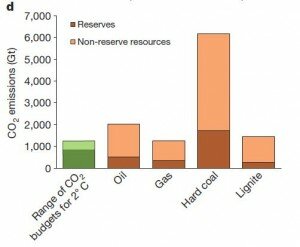
A new study in the journal Nature Climate Change examines the level of permissible greenhouse emissions to limit temperature increases to less than 2C relative to pre-industrial levels, Joeri Rogelj, et al., Emission Pathways Consistent with a 2C Global Temperature Level 1-6 (Oct. 2011). The study extends path-dependent assessments such as UNEP’s The Emissions Gap Report. Among the take-aways from the study:

  1. There is increasing evidence that we may need negative emissions “growth” to effectuate declines of temperature at a reasonable time scale; this is attributable to slow ocean mixing, which both delays warming associated with anthropogenic emissions and also limits amount of cooling for many decades to centuries. Technologies that might help effectuate negative emissions include carbon capture and sequestration (CCS) and bio-energy;
  2. Pathways with a “likely” (defined as greater than 66%) chance of staying below 2C requires median 2020 emissions of 44 Gt CO2e (compared to 48 GT CO2e currently), and 20 Gt by 2050;
  3. Atmospheric concentrations of CO2 in 2100 consistent with a 2C target are approximately 425ppm, or 465ppm CO2e;
  4. For more scenarios in the study’s data set, stabilization of emissions in 2030 is more consistently with a “likely” chance to stagy below 3C instead of 2C.

This is an excellent reading in a module on long-term responses to climate change. The conclusion that 70% of the scenarios that provide emissions pathways that hold temperatures below 2C require negative emissions could stimulate some good discussion about the importance of CCS technologies in future climate change policy portfolios, or geoengineering technologies, e.g. air capture or ocean iron fertilization. This piece also would provide excellent data for in-class cliamte simulations.


CEDD Materials on Climate Change

The  Climate Change Education Initiative team of the National Council of Science Education, funded by NASA, has developed 8 self-contained modules for undergraduate general education on climate change.  The modules,  using NASA data and web materials,   is presently available on the Encyclopedia of Earth.  They include:

NASA Time Machine –

Climate Change Impacts on Colorado River water supply -

Seasonality -

Introduction to Remote Sensing Metrics -

Advanced Topics in Remote Sensing

Ice Core Data  -

Recent Climate Change -

Climate Change and Wine -

Educators will have access to a parallel web portal to assist in course development.  An additional web portal permits communication among students at participating institutions.  Online pre- and post-course assessments are available to determine student knowledge and attitudes about climate change. There are also online post-module assessments for each unit.  Instructors will obtain data from their institution and aggregate summaries.  Each unit has been tested at the author’s institution and we now are recruiting additional faculty members to utilize the materials in their classes.  This development was funded by a NASA Global Climate Change Education grant “Creation and Dissemination of an Interdisciplinary Undergraduate General Education Course on Climate ChangeNNX09AL64G.

Website:

http://www.eoearth.org/article/NCSE-NASA_Interdisciplinary_Climate_Change_Education

The following link will allow you to access the webinar on using the NASA material.

https://ncse.webex.com/ncse/ldr.php?AT=pb&SP=MC&rID=1787637&rKey=1b54d347db082941

For assistance, contact:

Andy Jorgensen, Department of Chemistry, University of Toledo,

andy.jorgensen@utoledo.edu  419-530-4579


Impacts of Warming on Species

A new study published  in the journal Science demonstrates that warming trends are producing startling shifts of species, with the portent of much greater ramifications in the future. The researchers conducted a meta-analysis of latitudinal and longitudinal range shifts for a range of species from different taxonomic grounds in several regions, including Europe, North and South America and Asia and correlation with temperature increases. Among the take-aways of the study:

    1. Species have moved away from the equator at a median range of 16.9 km. per decade -1; for elevation, the analysis revealed a median shift to higher elevations of 11.0 m uphill per decade -1. This is a rate three times greater than found in previous studies;
    2. Unlike previous studies demonstrating nonrandom latitudinal and elevational changes without establishing statistical  linkages between range shifts and warming, this study found a significant correlation between shifts and warming, though with a weaker correlation in terms of elevational shifts;
    3. The rates of latitudinal and elevational shifts are substantially greater than that found in a previous meta-analysis, and increase with levels of warming;
    4. The variation found within taxonomic groups was so substantial that more detailed studies of physiological, ecological and environmental data are required to provide specific assessment for individual species;
    5. The ultimate fate of species in a changing world will be complex. As one of the researchers involved in the study, Chris Thomas of York University, recently concluded: “[r]ealization of how fast species are moving because of climate change indicates that many species may indeed be heading rapidly towards extinction, where climatic conditions are deteriorating. On the other hand, other species are moving to new areas where the climate has become suitable; so there will be some winners as well as many losers.”

This would be a good reading for a module discussing current impacts of climate change; it’s also a good case study of the complexity of climate science as it includes a good discussion of the interaction of climatic and non-climatic factors and multi-species interactions, and is yet another example of why operationalizing the precautionary principle is salutary in the context of climate change policy.